.png?w=1280&h=354)

1. Why You Need to Understand Zisha Potter Ranks
If you are spending $500 or more in a Yixing teapot, you will inevitably encounter descriptions like: "This pot is fully-handmade by L4 Senior Master Artist XXX."
The questions that follow are usually: What does this title and rank actually mean? How much is it worth? Should I be paying hundreds or even thousands extra for it?
The answer is: Understanding the professional title/rank system is crucial for any mid-to-high-end Yixing purchase.
When you buy a teapot for $1,000, roughly $700 of that price stems from the potter’s "brand premium." This premium consists of their title, honors, auction history, and market reputation. Among these, the professional title is the most objective and transparent—because while honors can be faked, the title is a hard credential issued by the government and searchable in official databases.
Unfortunately, most English translations online are inaccurate, particularly by overusing the words “Artist” and “Master,” which creates significant misunderstanding. This guide aims to provide international buyers with a clear, accurate, and practical understanding of the ranking system.
|
Rank |
Title in Chinese |
Literal Translation |
TL;DR |
Number of People |
Proportion 1 (Among all potters with professional titles) |
Proportion 2 (Among all Zisha Potters) |
Issuing Authority |
|
Level 1 |
工艺美术员 |
Arts and Crafts Member |
Intern Artisan |
~600 |
7% |
1.0% |
Yixing Municipal Human Resources and Social Security Bureau (宜兴市人力资源和社会保障局) |
|
Level 2 |
助理工艺美术师 |
Assistant Arts and Crafts Artisan |
Junior Artisan |
~6000 |
66% |
10% |
Yixing Municipal Human Resources and Social Security Bureau |
|
Level 3 |
工艺美术师 |
Arts and Crafts Artisan |
Standard Artisan |
~1500 |
17% |
2.5% |
Wuxi Municipal Human Resources and Social Security Bureau (无锡市人力资源和社会保障局) |
|
Level 4 |
高级工艺美术师 |
Senior Arts and Crafts Artisan |
Senior Artisan |
~600 |
7% |
1.0% |
Jiangsu Provincial Department of Human Resources and Social Security (江苏省人力资源和社会保障厅) |
|
Level 5 |
研究员级高级工艺美术师(正高级) |
Researcher-level Senior Arts and Crafts Artisan(Full Senior) |
Grand Artisan |
~350 |
4% |
0.6% |
Jiangsu Provincial Department of Human Resources and Social Security |
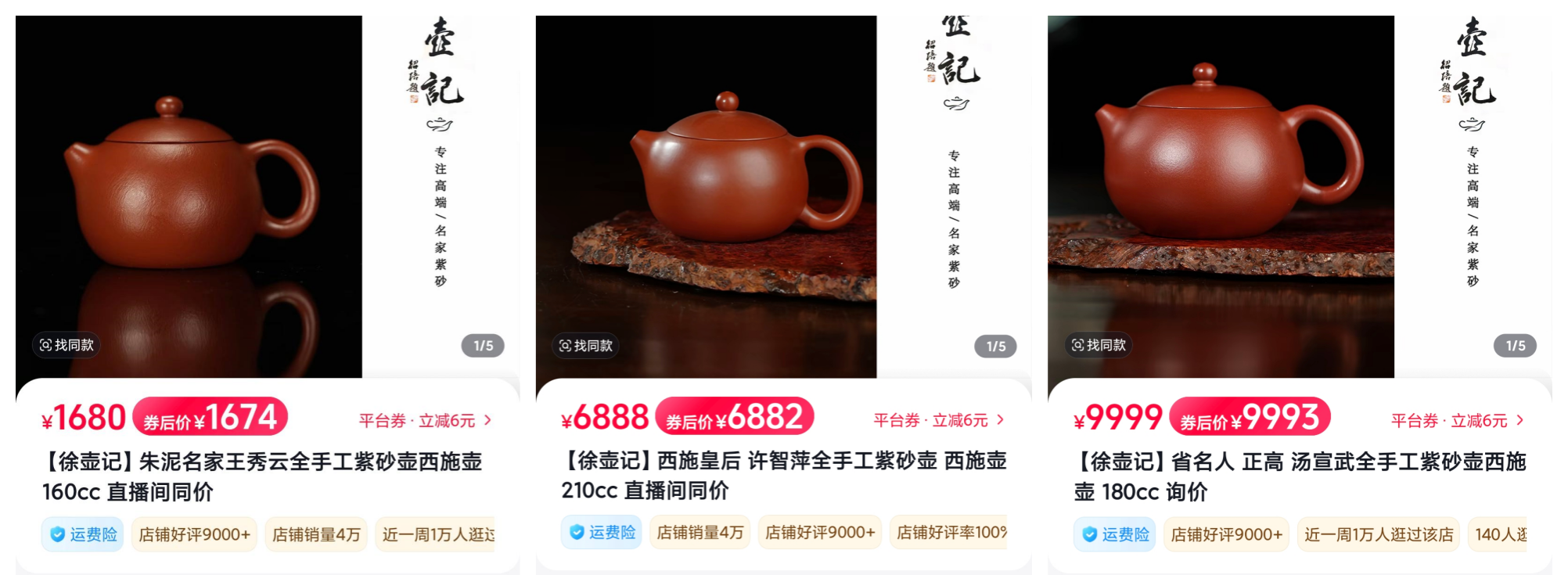
Similar Xishi teapots from the same online shop,
crafted by artisans at L2, L4, and L5 respectively
You can see the price progression here.
2. Two Fundamental Facts First
Fact One: Titles≠Mandatory Licenses
Out of the 60,000+ potters in Yixing, less than 15% hold professional titles. Unlike medical or academic titles, these are skill level certifications backed by the government, not mandatory licenses. Eligible potters voluntarily register for the evaluation and examination.
Fact Two: Artisan, not Artist or Master
The core term in the ranking system is “Arts and Crafts Artisan” (工艺美术师). Please note:
- It is NOT “Artist”: Most potters (even at L4 and L5) just “replicate” or “refine” classical stylesfrom history, rather than create original art. Therefore, they are better described as Artisans (craftspeople) rather than Artists.
- It is also NOT “Master”: In the Zisha world, “Master” has a specific definition—it is the highest honorary title bestowed by the government, and essentially only L5-level potters are eligible to participate in the selection process. While I find the notion that a 'Master' requires government certification to be inherently absurd,using the word “Master” to translate professional titles is not just incorrect—it is deceptive.
3. Complete Guide to the Title System (Updated March 2026)
This professional title system was established in the 1980s and has undergone several policy adjustments. Below is an explanation of each level based on the current situation:
L1: Arts and Crafts Member
|
Criteria |
Details |
|
Eligibility & Experience |
At least 3 years of professional experience |
|
Works & Honors |
Submit 3+ works(independently completed), with at least 1 selected for municipal-level exhibitions |
|
Publications & Research |
None |
|
Examination Process |
Theory exam + Live skill evaluation + Expert review and defense |
Comment: For “premium value,” it’s essentially negative—like wearing a “rookie” sign. Most L1 potters strive to upgrade as quickly as possible.
L2: Assistant Arts and Crafts Artisan
|
Criteria |
Details |
|
Eligibility & Experience |
5 years after L1, or at least 8 years of professional experience |
|
Works & Honors |
Submit 5+ fully handmade works, with at least 1 winning provincial-level awards or being shortlisted |
|
Publications & Research |
Publish short articles in industry journals, or submit 1+ professional skill summaries |
|
Examination Process |
Theory exam + Live skill evaluation + Expert review and defense |
Comment: This used to be the mid-level rank but now counts as entry-level. Nevertheless, most potters’ ranking journeys end here—the higher you go, the stricter the requirements and the fiercer the competition.
Counterintuitive Fact: The number of L2 potters (~6,000) far exceeds L1 (~600). This is because, after policy reforms around 2010, potters with bachelor’s degrees or higher could directly apply for L2, and most of the newer generation meet this educational requirement.
L3: Arts and Crafts Artisan
|
Criteria |
Details |
|
Eligibility & Experience |
5 years after L2, or at least 15 years of professional experience |
|
Works & Honors |
Submit 5~8 representative fully handmade works; winning ≥2 national gold awards or ≥3 provincial gold awards; or have ≥2 works collected by municipal/ provincial museums |
|
Publications & Research |
Publish ≥2 papers, or 1 monograph |
|
Examination Process |
Theory exam + Live skill evaluation + Expert review and defense |
Comment: Potters at this level are primarily veterans with over a decade of experience. They typically have independent studios, mentor apprentices, and lead relatively decent lives.
L4: Senior Arts and Crafts Artisan
|
Criteria |
Details |
|
Eligibility & Experience |
5 years after L3 |
|
Works & Honors |
Submit 8+ representative fully handmade works, including 3+ award-winning pieces from major national exhibitions; or have ≥1 work collected by national/provincial-level art museums |
|
Publications & Research |
Publish ≥2 core journal papers, or ≥1 monograph |
|
Examination Process |
Theory exam + Live skill evaluation + Expert review and defense |
Comment: The requirements are extremely strict, so this rank carries significant weight. Potters at this level are all genuinely “skilled” and “experienced,” almost exclusively middle-aged (45+) professionals.
Controversy: Rules have loosened in recent years—some potters can now obtain this rank through “shortcuts” (e.g., winning specific competitions), which has sparked debate within the potter community. Government websites and authoritative databases note these “non-exam” L4 potters in their profiles.
L5: Researcher-level Senior Arts and Crafts Artisan
|
Criteria |
Details |
|
Eligibility & Experience |
5 years after L4 |
|
Works & Honors |
Submit 10+ representative works, including 5+ national gold award winners; preference for works collected by national museums |
|
Publications & Research |
Publish ≥3 high-level papers and ≥1 monograph, lead ≥1 provincial/ministerial research projects |
|
Examination Process |
Pass blind review of works + Final defense by the national-level expert pool |
Comment: This is the pinnacle of the system. Unlike L1-L4, this level is awarded through through evaluation and selection rather than examination, requiring not just skill but also professional network and prestige. Basically, only L5 potters are eligible to compete for officially recognized “Master” titles.
【Notes on Eligibility & Experience Flexibility】
- Potters with master’s or doctoral degrees face significantly reduced experience requirements. For example, ceramics majors with master’s degrees can directly obtain L2 (through review only, no exam required).
- Other official titles/honors may also relax experience and publication requirements.
- Policies are continuously adjusted, making the situation complex. This article doesn’t cover every detail. For deeper research, consult the official government documents listed in the “References” section.
4. Controversies and Flaws
No human-run system is perfect, and this professional title system is no exception. Below are the common concerns from both potters and consumers, as well as the challenges the system faces today.
4.1 Potters’ Complaints: Connections and Corruption
Issues manifest in two main ways:
- Pre-exam“networking”: Potters contact judges before exams to gain advantages, after all, the Zisha circle is small, and everyone knows everyone else. Of course, since so many do this, “if everyone does it, it’s like no one did,” and all participants are under the same roof in live skill evaluation, so basic fairness is still maintained.
- “One-stop” services: Winning competition awards, having works collected by museums, publishing journal papers—these requirements sound impressive but vary widely in actual value, and can often be arranged through connections and gifts. Some have even spotted business opportunities, offering complete services to handle these requirements (for a considerable fee, of course).
My opinion: Rejecting the entire system based on these flaws is unreasonable. While I’m not a “big government advocate,” compared to profit-driven dealers, fee-charging private organizations (often with misleading names suggesting official status), opaque auction agents, and internet influencers with loose tongues—I still trust the government more. Without this professional title system, the market would become even more chaotic.
4.2 Consumers’ Complaints: Is the Rank Premium Worth It?
Consumer complaints mainly fall into two categories:
1. Quality Doesn’t Match Premium
You spend $1,500 on an L4 potter’s teapot (classic style). Years later, with more knowledge and experience, you realize the craftsmanship and details aren’t much different from a $100 entry-level pot. If you bought an original design, once you’ve developed your aesthetic sense, you might find the design “tacky” or poorly conceived.
2. Resale Value Falls Short
After that, you decide to sell the pot on the secondary market, but after listing it, no one will pay even $500. You approach the dealer or even the potter himself to return it—though you’ve never used it—and they’ll only buy it back for $150…
Whose fault is this?
These situations are common in the Zisha market and the broader crafts market, and they have little to do with the title system itself. This mainly reflects potters’ professional ethics, and the title system has no power to enforce these standards, nor does it provide ongoing supervision or assessment.
For many, obtaining a professional title is seen as the ultimate finish line. Once they reach their target rank, they often “lie flat”— ceasing to refine their skills or seek new artistic breakthroughs. Paradoxically, their craftsmanship may even decline compared to their pre-exam days; just like how you forget much of what you crammed after the final exam. The situation might improve significantly if the government implemented periodic skill re-assessments after granting these titles.
3. The Worse Case: “Ghost-making”
Some potters stoop lower: they treat their professional as leasable fixed assets. Dealers pay annual fees to “rent” these potters’ usage rights. Then, dealers commission other potters or workshops to mass-produce imitations of the potter’s past works, finally stamping the potter’s personal seal for sale. These potters cooperate, confirming the pots as their own handiwork—certificates, photos, video verification—all available. This is known in the industry as “ghost-making” (代工). To control costs, these ghost-made pots are usually average quality at best—they’re essentially “products,” not “works.” Even some famous officially recognized “Masters” have been caught doing this.
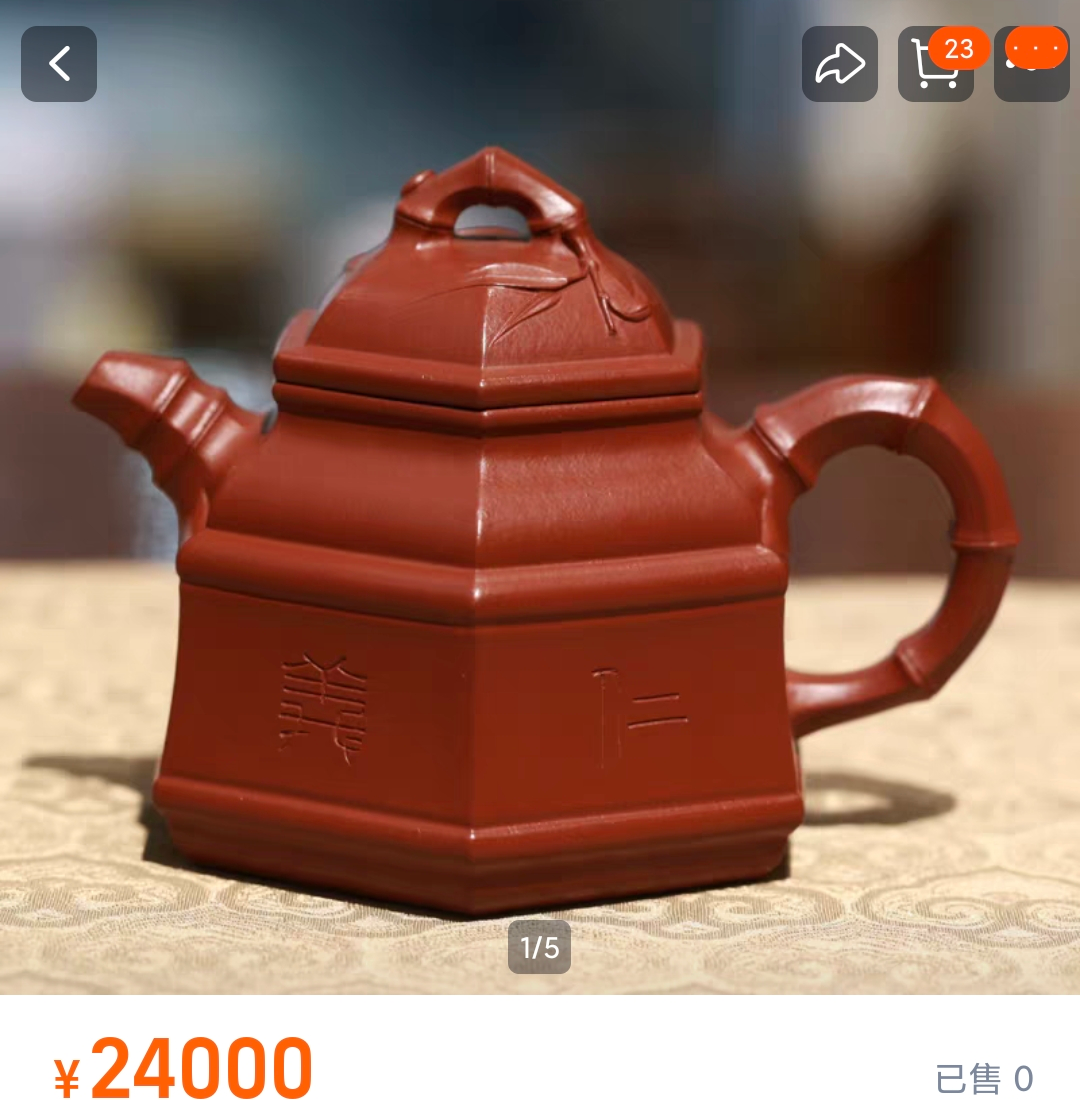
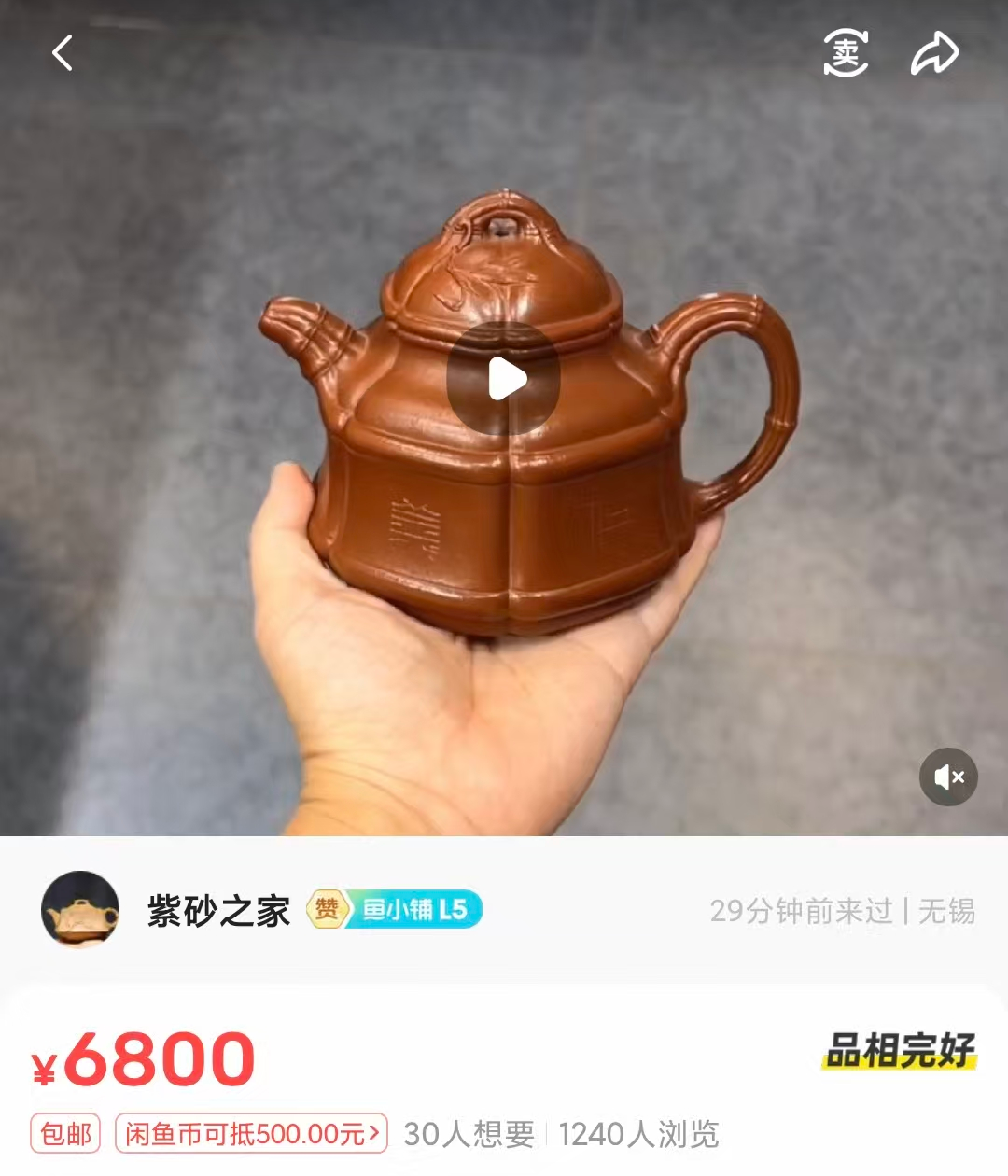
Same teapot from the same potter, a brand-new one is priced at ¥24,000,
while an unused, like-new piece on second-hand trading platforms costs only ¥6,800.
4.3 “Fake Titles”: A Dark Past
During the early 2000s (2000-2010), the Zisha market experienced wild growth. With many consumers lacking discernment and blindly trusting ranks, combined with underdeveloped information systems and imperfect regulations, fake titles became rampant.
These fake title issuers used names designed to confuse, making you think they were official institutions (some actually had government background). Potters simply need to find the right "channels" and pay a significant fee to acquire titles like “National-level Senior Arts and Crafts Artisan” or even “National-level Ceramic Master", coming with certifates to prove authenticity. These institutions faced little legal risk—they claimed to issue “industry honorary titles,” not “professional skill ranks.”
At its craziest, professional forgery teams emerged—potters could specify any rank, title, or issuing institution they wanted, and certificates would be “created”. People who couldn’t make teapots at all transformed into “Zisha Masters,” hiring others to make pots and, as long as they could sell them, reaping huge profits.
Thanks to years of governmental crackdowns, oversight and the launch of a publicly accessible official database, this issue has eased considerably - yet this dark chapter has caused irreversible damage to the whole Zisha market.
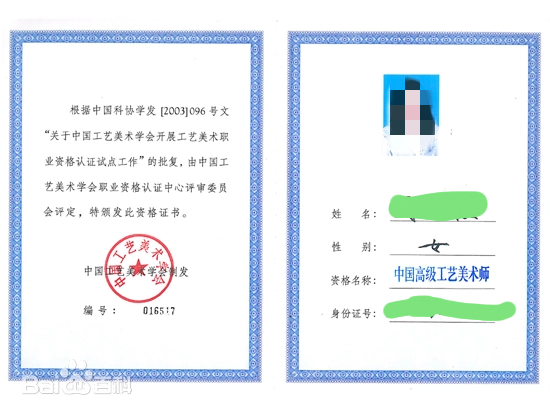
Example of Fake title’s certificate
Issuer: China National Arts & Crafts Society
Title: National Senior Arts and Crafts Artisan
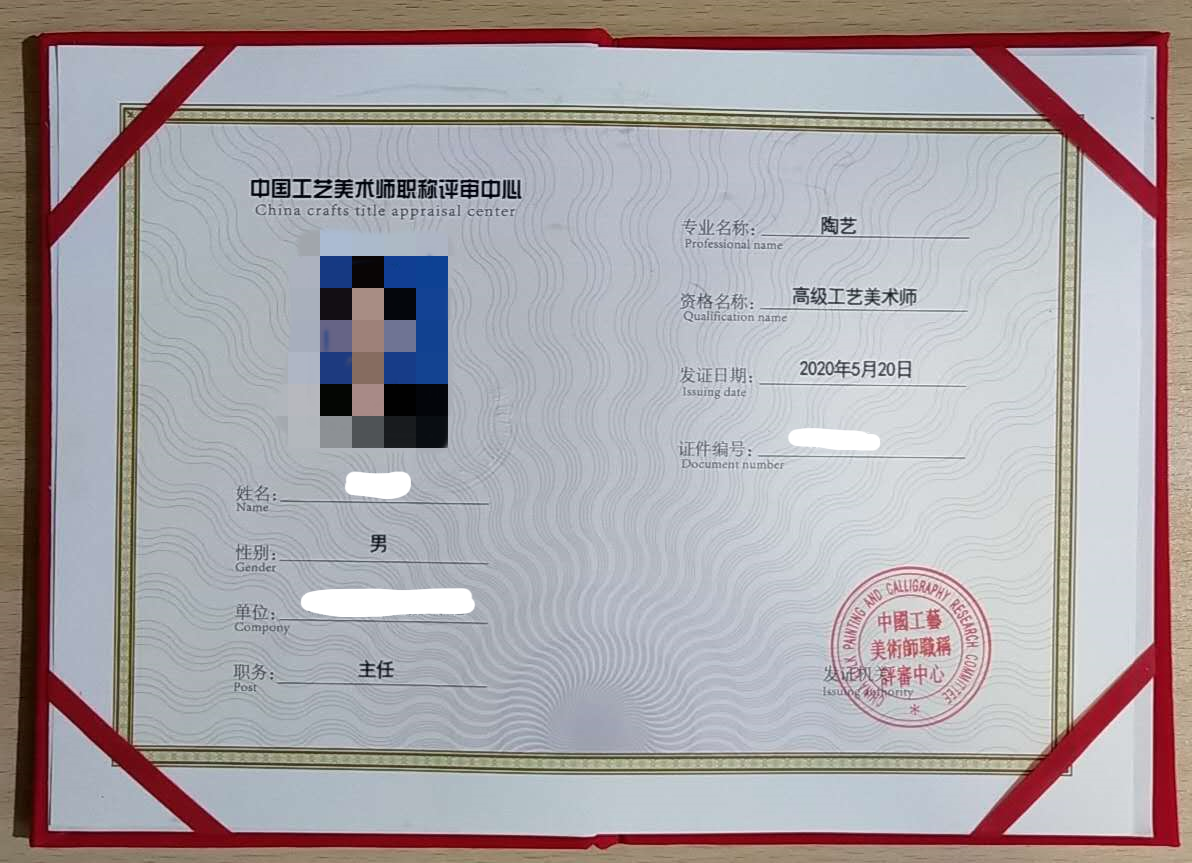
Another example of Fake title’s certificate
Issuer: China crafts title appraisal center
Title: Senior Arts and Crafts Artisan
4.4 Rebels Outside the System: Why “Rank Doesn’t Matter”
Back to the initial question: Why only 15% of potters enter this system?
A realistic reason: Most potters will never reach L4 or even L3 level requirements in their lifetimes. For example, if a potter stuck at L3 for 20 years, he/she will inevitably gets labeled “mediocre.” Rather than endure this awkward middle ground, some choose to remain unbound by the system.
Of course, if you ask them directly, they probably won’t admit this—they’ll just say “titles are useless,” “exams are rigged,” or “senior artisans and masters are full of frauds.”
These statements aren’t entirely wrong. In fact, many L4 and L5 potters admit in private: “Titles are becoming increasingly meaningless.”
What truly undermines the system’s authority is that some of the best middle-generation potters (TOP 20 level at present, such as Li Hanyong, Li Hanming, Ren Beian, Gao Zhenyu) have actively chosen to stay outside the system entirely, holding zero titles or official honors.
These “system outsiders” showed talent early in their careers, secured powerful dealer support (eliminating livelihood concerns), built reputations through sustained creative work and marketing, and now exceed 90% of official “Masters” in quality, price, and market buzz.
They provide the best evidence for “rank doesn’t matter” arguments. They’ve not only helped consumers (especially high-end buyers) demystify ranks and “Masters,” but also inspired younger potters to follow their path and stay outside the system.
After all, most potters pursue higher titles to gain more premium space for their works, not for some grand vision of self-realization.
5. What to do as a consumer?
Having covered all the background, now we address the most practical question: As a consumer, how should you interpret these professional titles to make an informed and rational purchasing decision?
5.1 Step One: Verify Authenticity
While title forgery is rare nowadays, those who obtained fake titles in the past remain active in the market. So it’s still necessary to verify, here are 3 methods:
Method 1: Yixing Government Official Database
Note: Due to merger and migration across databases from different government levels, pre-2018 data is incomplete4.
Method 2: Authoritative Commercial Databases
Note: These sites have the most comprehensive data, including official honor titles.
Method 3: Ask AI Directly I’ve tested multiple AI models (including “trap” questions like identify pre-2018 titles and fake ones ); for now (March, 2026), only DeepSeek was 100% accurate.
Advice: Use at least two of these methods for cross-verification.
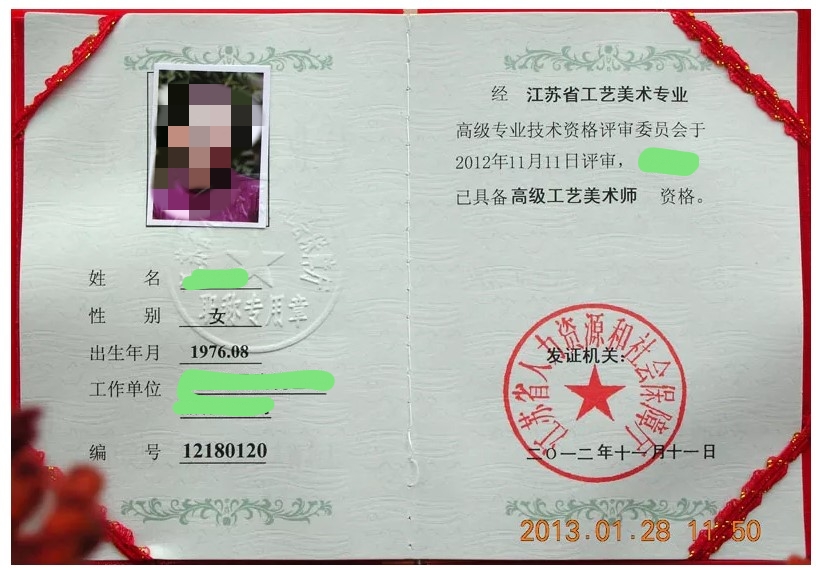
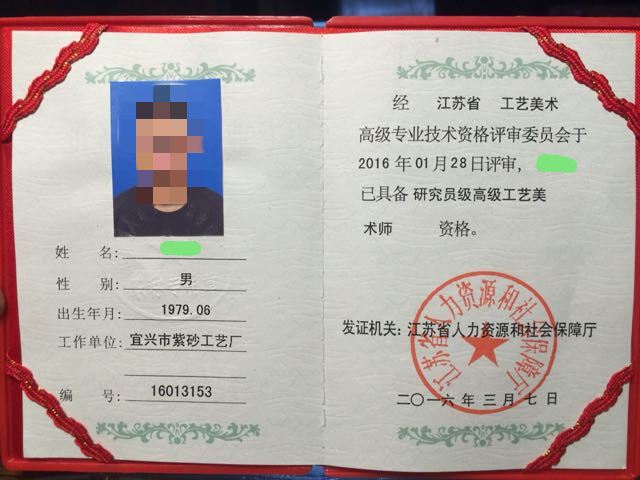 The image above shows a genuine certificate, while the one below is a forgery. The two are virtually indistinguishable to the naked eye, so it's necessary verify authenticity online.
5.2 Step Two: Managing Your Spending Expectations
Even if your budget is as high as $5,000, it is best to approach this as luxury consumption rather than art investment.
In the U.S., there is a well-known saying that a new car loses a massive chunk of its value the moment you "drive it off the lot." Yixing teapots often follow the same rule. You should be prepared for the worst-case scenario: that the piece could depreciate significantly the moment it changes hands. This remains true in most cases, regardless of the potter’s rank, even “Masters”.
5.3 Step Three: Back to the Teapot Itself
This is the most important step.
Before making your payment, perform this thought experiment: If you removed all the potter’s ranks and honors, would you still be willing buy this teapot at the current price? Just calculate how much premium you’re actually paying.
Ultimately, the best defense is to sharpen your own eye for quality. However, since expertise takes time to cultivate, beginners should adopt the "slowest" but most effective strategy: The Method of Comparison.
- Look for the same teapotstyle from other sellers and potters at different ranks, see which one truly resonates with you, and compare their prices.
- Ask experienced friends for opinions.
- Post on Reddit’s Yixing subreddit (r/YixingSeals) for community feedback.
5.4 Always Remember These Four Facts
In short, don’t repeat the mistake as Chinese consumers in 2000~2010s: blindly obsessed with ranks, completely equating a teapot’s quality and artistic value with the potter’s rank.
Fact One: Rank Is Not Leaderboard
If you look solely at the percentage breakdown in the first section of this article, you might jump to this conclusion: the actual skill level of an L5 artisan places them in the top 0.6% of all potters, while an L4 artisan sits in the top 1%.
Statistically speaking, this assumption is entirely false—simply because the vast majority of potters have never taken these exams in the first place. By the exact same logic, an L4 artisan is not necessarily a better craftsman than an L2 artisan.
Fact Two: Within Same Rank, Worlds Apart
What are the standard price ranges for each rank? It’s hard to answer because there’s no “ceiling.” The gap in skill and pricing between potters of the same rank can be vast—the works of certain young L2 potters already command prices exceeding ¥50,000, more expensive than those of most L5 potters.
Therefore, I can only provide minimum reference prices (if significantly lower, better be careful):
|
Rank |
Minimum Reference Price (excluding international shipping and tariffs) (USD) |
|
L1 |
$100 |
|
L2 |
$200 |
|
L3 |
$500 |
|
L4 |
$900 |
|
L5 |
$2000 |
Fact Three: Are Ranked Potters’ Teapots Always “Authentic”?
If by “authentic” you only mean “genuine Zisha clay” and “traditional half-handmade/full-handmade”, without considering aesthetics, craftsmanship details, or ghost-making issues—in today’s market, I’d say 95% probability is yes. When buying teapots from ranked potters, most Chinese consumers worry less about “authenticity” than about “worth the money.”
Fact Four: The Future of the Title System
As more top potters choose “system outsider” paths, and as consumer awareness grows, the halo of titles is gradually fading. But again, this doesn’t mean the system is worthless—it’s still the most objective, quantifiable indicator available. The key: Treat it as reference, not principle.
6. Conclusion
The world of Zisha is vast and profound; professional titles are merely one of many gateways into this realm. My hope is that this article helps you establish a rational perspective on these ranks, allowing you to approach your next purchase with greater poise and confidence. Whether you ultimately choose a high-end work by an L5 grand artisan or an original piece from a young, untitled potter, the most vital question remains: Does that pot truly speak to you?
After all, a Zisha teapot is made for brewing tea, and kept for the companionship it provides.
【References】
- Yixing City Human Resources and Social Security Bureau. Professional Rank Assessment Management Measures (2024 Edition)
- Yixing Ceramics Industry Association. Zisha Potter Rank Statistics Report (2025)
- Jiangsu Province Arts and Crafts Title Qualification Conditions (Su Zhi Cheng [2023] No. 12)
- Statement Regarding Professional Title Inquiry in Wuxi(08/09/2023)