

If you are exploring Gongfu tea or looking for your first authentic teapot, you will quickly encounter the term Zisha (紫砂, Purple Clay). Originating in Yixing, China, this unglazed ceramic ware has been praised by tea connoisseurs for over five centuries.
Yet behind the romantic stories and colorful marketing names lies a confusing web of terminology. Is authentic clay found only in Yixing? How do different clays affect tea? And what actually makes a clay "good"?
Here is a straightforward, insider guide to the fundamentals of Zisha clay.
1. Is Zisha Clay Found Only in Yixing?
In short: No.
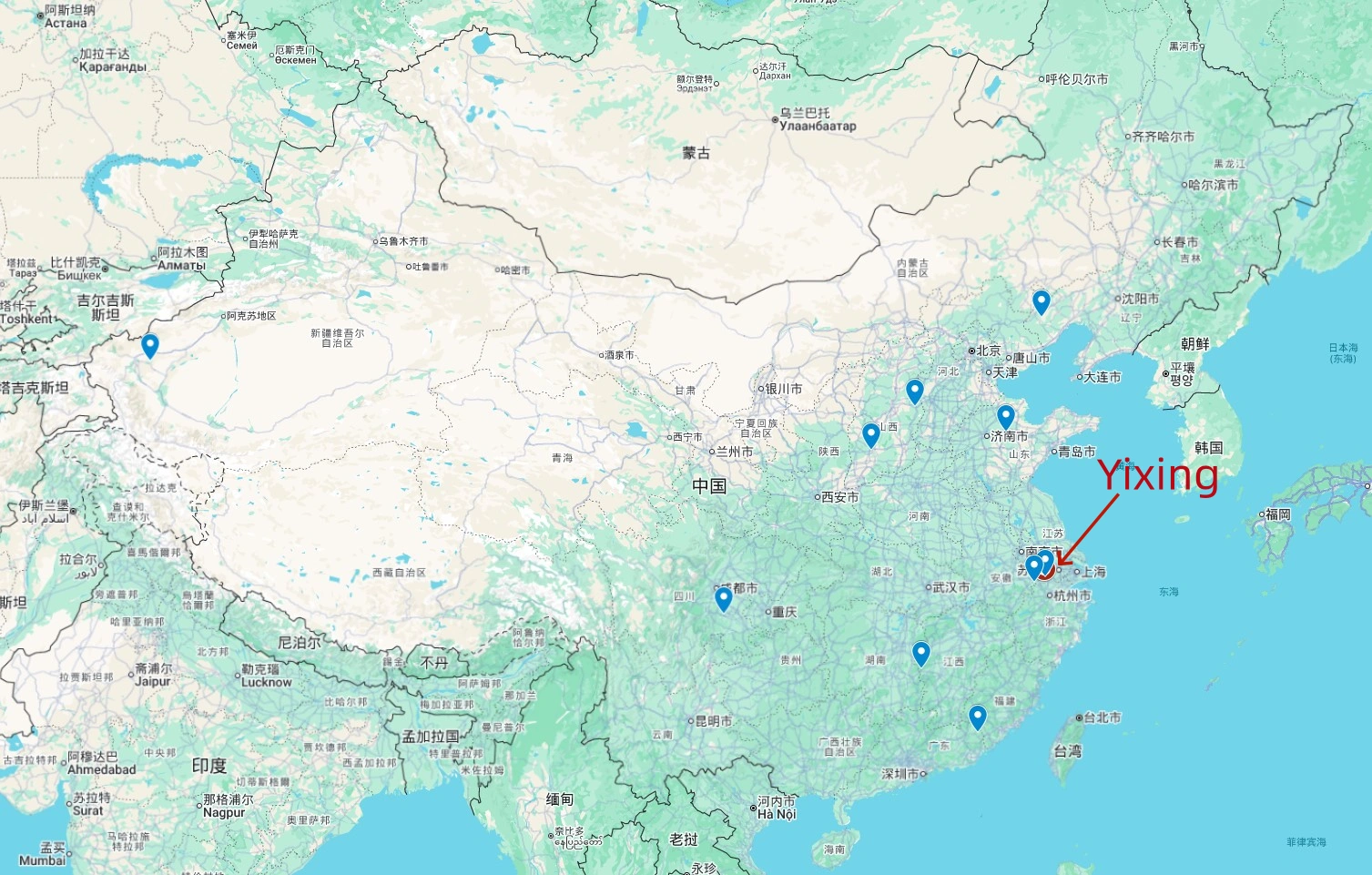
From a geological perspective, iron-rich reddish earthenware clays and sandy shales exist in many parts of the world. However, mineral deposits with physical properties closely resembling Yixing clay are relatively rare. Most regional deposits are simply standard brown or red earthenware clays; only a small number can be geologically classified as Zisha and used for making Zisha ware.
Take China as an example. Kazuo in Liaoning (northeast) and Jianshui in Yunnan (southwest) are over 3,000 kilometers apart. Both have reddish earthenware resources, but the materials are quite different. Kazuo clay is closer to Yixing clay in nature, and since the 1950s it has gradually built a Zisha industry chain similar to Yixing’s. Jianshui clay, on the other hand, is a traditional colored clay that developed into Jianshui purple pottery—a completely different craft system from Yixing Zisha.
Geologically, the deposits closest to Yixing are found in neighboring Changxing (Zhejiang) and Guangde (Anhui). These two cities are adjacent to Yixing, and their underground geological veins are actually connected.
Today, large volumes of Zisha ware production—including planters, teacups, tea pets, and everyday dinnerware—rely on these neighboring deposits. Authentic, carefully aged native Yixing ores are far scarcer and are reserved primarily for mid- to high-end handcrafted Yixing teapots.
2. What Makes Yixing Clay Different from Regional Clays?
Objectively speaking, it’s not simply a matter of “good vs. bad.” But native Yixing ore is undoubtedly the best fit for Zisha teapots—its plasticity during shaping, distinctive sandy visual depth, and natural breathability (the double-pore structure) remain unmatched.
Here are a few specific comparisons:
-
Changxing Clay (China): The granular aggregate structure is slightly weaker than Yixing ore. When shaping thin-walled bodies or intricate parts, the risk of cracking during drying and firing is higher.
-
Kazuo Clay (China): Higher calcium content makes the fired body brittle and hard. The particle texture is flatter, and the visual depth and warm, moist quality fall noticeably short of Yixing Zisha.
-
Indonesian Clay: Rich in iron but composed of extremely fine volcanic sediment. It lacks the internal quartz-sand skeleton of Zisha, making it better suited for traditional rustic earthenware.
-
Tokoname Red Clay (Japan): As early as the Edo period, it was used to imitate Yixing red clay teapots. The color is similar, but the particle structure, workability, and the breathability and patina effects differ significantly from original Yixing.
3. What is "Good" Clay?
For consumers, “results-oriented” is more reasonable than “origin-only” thinking. The final judgment must rest on the finished piece itself.
For example, with Zisha flower pots or tea pets, the focus is on form or playfulness, not on showcasing the clay’s texture. Using high-quality regional clay is not only perfectly adequate but also more cost-effective.
For zisha teapots, however, raw ore sourcing is only step one. How the clay was weathered, crushed, and aged (Chen Fu), how skillfully the artisan paddled the clay, and how precisely the kiln firing was controlled all profoundly affect the final reuslt. A fine Yixing teapot rests on three pillars: Clay, Form, and Craftsmanship. Clay is only one part of the triad. Even the most “authentic” ore, if poorly crafted or improperly fired, ends up being nothing more than wasted material.
Among high‑end Yixing teapot circles, collectors and artisans rarely obsess over clay nomenclature. Premium clay is the baseline expectation—much like you evaluate a Picasso painting by its composition and expression, not the brand of oil paint on his palette.
There are countless unexplored clay deposits around the world. It's entirely possible that some could fully match the quality of Yixing’s original ore.
4. How Many Types of Zisha Clay Are There?
Today’s market is flooded with fanciful clay names: Dragon Blood Sand, Imperial Scarlet (Da Hong Pao), ROC Green, Ivory Duan Ni, and many others. Most of them were invented over the past two decades for marketing purposes, lacking standardized mineral classifications. Even lifelong Yixing potters cannot recognize them all.
According to traditional industry consensus, authentic Zisha clay is divided into three primary mother ores, two natural symbiotic ores, and a handful of rare specialty minerals. This is the most authoritative and widely used classification system.
| Geological Classification | Primary Category | Benchmark Sub-Varieties |
|
Primary Mother Ores
|
Zi Ni
(Purple Clay)
|
Di Cao Qing, Qing Shui Ni, Tian Qing Ni |
|
Hong Ni & Zhu Ni
(Red & Cinnabar Clays)
|
Zhaozhuang Zhu Ni, Xiaomeiyao Zhu Ni, Classic Hong Ni | |
|
Lv Ni
(Green Clay)
|
Ben Shan Lv Ni, Mo Lv Ni, Hong Ma Zi Lv Ni | |
|
Natural Symbiotic Ores
(Organic geological intergrowths)
|
Duan Ni (Tuan Ni)
(Fortified Sand Clay)
|
Golden Duan Ni, Qing Duan Ni, White Duan Ni
(Natural intergrowth of Zi Ni and Lv Ni)
|
|
Jiang Po Ni
(Downslope Ore)
|
Red Jiang Po, Yellow Jiang Po, Green Jiang Po
(Natural blend of Hong Ni, Duan Ni, and Zi Ni)
|
|
|
Specialty Natural Minerals
(Secondary or rare deposits)
|
Mineral Additives
(Cannot form a vessel alone)
|
Shi Huang, Shi Hong
(Mainly for colour‑toning and modifying clay properties)
|
|
Rare Historical Ores
(often imitated with blends on the market today)
|
Ben Shan Wu Ni, Gui Hua Ni, Qing Hui Ni, Long Gu Jin Sha |
In upcoming articles, we will explore each of these major clay families in depth—covering their geological traits, optimal tea pairings, and how their patina develops over years of daily brewing.
---
References & Further Reading
- Li, Hongyuan (李洪元). (2015). Atlas of Yixing Zisha Mineral Sources (《宜兴紫砂矿源图谱》). Geological Publishing House (地质出版社).
- Zhu, Zewei & Shen, Yaqin (朱泽伟、沈亚琴). (2009). Yixing Zisha Mineral Ores (《宜兴紫砂矿料》). Geological Publishing House (地质出版社).
- Hou, Jiayu, Kang, Baoqiang, et al. (侯佳钰, 康葆强等). (2016). "A Comparative Study on the Characteristics of Zisha Raw Materials from Huanglong Mountain, Yixing" (《宜兴黄龙山紫砂原料特征的对比研究》). Journal of Ceramics (陶瓷学报), 37(4), pp. 418–424.
- Gao, Xuyang. (2023). Unravelling the Complex Meanings and Origins of Zisha Teapots. DPhil dissertation, University of Oxford.